As I talk with Katharina Wulff, the sun slowly sets in Umeå, northern Sweden, and the April snow is gradually melting outside her windows. — quite a bit earlier than expected for this season. It is “spring-winter”, usually the favorite season for snow activities, but the climate’s unpredictability has ended this. Katharina has immersed herself in daylight/solar research over the past +10+ years, combining it with her earlier research in human behavior, circadian sleep, and mental health.
Carlo Volf, PhD
For sure, Katharina is taking her scientific knowledge to the test, as she has been deeply involved in the architectural planning of her own house, located at 64 °N amidst regionally dynamic daylight characteristics: During winter, the sun rises only 3° over the horizon, providing a mere 4 hours of daylight, with 4-hour high albedo, snow-reflectivity, semi-darkness, and a 16-h night sky for stargazing and Northern Lights.
Summer is the reverse: no star watching. Instead, the sun disappears briefly below the horizon at 23.00, only to rise again at 02.15. It seems abundantly clear that Katharina has the scientific and applied experience of planning a healthier architecture. This opens many perspectives on how biology and life up north can inspire the architectural planning of our built environment.
Q: Your work is guided by the belief that natural light and an understanding of circadian rhythms are vital for designing buildings that safeguard people’s health. Please share how you reached that conclusion.
I pay particular attention to the temporal function of natural light, such as day length, twilight, and dim light across 24 hours, and I focus on the body’s responses to daily and seasonally changing light-dark cycles. Specifically, I am using the fast tempo of seasonal change as a tool in my research to better understand how natural light affects people differently and how manmade surroundings — the result of architectural planning—can amend or weaken our physiology.
As a biologist, I view humans as just another day-active primate species. As such, we live in families, sleep in beds, and express sophisticated social behavior; our predominant sense is vision. Our field of vision spans an incredible 160 degrees, and we have about 100 million photoreceptors. These sensors capture different wavelengths of light, and the optic nerve carries this temporal pattern to other parts of our brain. Rod photoreceptors are so sensitive that they can absorb individual photons, necessary for seeing objects at night.
Cone photoreceptors are far fewer than rods, but capture the color we see during daylight. Yet another photoreceptor type is sparsely located in retinal ganglion cells. They transmit time from the sun’s path directly to our body clock. Finally, daylight length is key for the temporal regulation of hormone production, sleep, and immune defense, to name a few.
I think architecture and the indoor environment should be adapted to local environmental conditions. There should be plenty of opportunities to directly access natural daylight and outdoor greenery through openable windows, doors, courtyards, and footpaths bridging the interior and exterior.
Looking at different cultures, vernacular architecture has resulted in precise architectural planning of these elements in balance with nature, trees, and ground surfaces. However, the single-family and terraced houses from the 1950s to 70 in Umeå’s residential areas Berghem or Ålidhem serve as poor examples of good and healthy architecture.
With their small windows and low ceilings, the focus was on energy performance rather than daylight necessity for human health. Historically, this period was not a good time for daylight planning. But when I look at the newest buildings, the result is more satisfactory. It appears that integrating perspectives from people knowledgeable of human nature for developing and implementing architectural models seems to pay off richly without being economically costly.
Today, Sweden has the highest percentage of prefabricated wooden residential houses worldwide.
Unlike other countries, the Swedish government sets goals with a performance code, and manufacturers devise their own ways of achieving them. This allows modern buildings to have larger windows compared with the 1960-s.
Hence, today´s architectural planning has picked up again on our sensitivity to natural light exposure and local surroundings. The communication between people knowledgeable about human nature, municipalities, investors, and architects is improving.
Umeå is one of the fastest-growing cities in Sweden. The city is part of the European “5km from centre /15 minutes city” concept, an urban concept based on bike riders and pedestrians, with architectural planning to protect green areas and separating cars from residents with car-free front yards. It makes it easier to get to know your neighbors and to make the most of the scarce winter daylight is easier.
For example, a new development, Tomtebo gård, has been planned for 1000 townhouses and apartments. The area is arranged in a semi-close block structure of various designs, volumes, and courtyards with good light and space for playing, growing vegetables, and socializing.
Q: Do you think your perspective applies only regionally (for example, in Umeå) in contrast to other regions (e.g., Germany)? If so, how? Specifically, how might Nordic buildings differ from those elsewhere? Tell us about your favorite buildings. How do they reflect evolving concepts about daylight and circadian rhythms?
A sundial is a perfect metaphor for body clocks and healthy buildings. The sun’s movement tells the passage of local time-of-day and that of season from the position and length of the moving shadow.
Importantly, Sundials are bound locally! This also applies to our body clock as it does to buildings: A sundial from the upper 60th N latitude is useless at the lower 40th, because it violates necessary adaptation and gives you the wrong time.
Equally, the wrong building orientation and small windows hamper our sensory daylight capture for our body clock to adapt“.
The regional climate and daylight determine the material, building orientation, and room distribution for any place on Earth. Cold winds, dry air, and significant seasonal changes all demand specific architectural considerations and adaptations towards higher latitudes. Some key principles are essential and universally applicable in regional architectural planning.
A house must:
- Acknowledge and respect the seasonal path of the sun.
- Support human physiological responses to daylight changes under local seasonality.
- Include spaces, that react sensibly to seasonal outdoor changes and allow occupants to easily adapt and control the indoor environment.
I adopted these key principles in our house. Its envelope is only made from local arctic spruce and glass. Through openable high-placed windows and dynamic ventilation, I can easily control different airflow and temperatures, as well as let out insects during summer.
Dynamic indoor lighting of varying color temperatures allows us to adjust lighting, i.e., complementing the 4-hour twilight in the winter morning/afternoon with additional shortwave LED light. We then switch to warm LED in the winter evening.
Originally, the land was forest. To develop something circadian, I started visiting the deforested site regularly for about a year to study seasonal variations of the passage of the sun and the directions of the winds, always using a compass. Subsequently, I studied the solar angles and heights theoretically, adding my on-site experiences to the patterns of the sun. The building shape was derived as a result of this.
Due to these daylight studies, I wanted a house with obtuse angles to capture seasonal differences in daylight. But the local architect was out of his depth. Only when we turned to collaborate with international architects ‘Fusionstudio’ (https://fusionstudio.eu/umea-house-sweden/), obtuse angles were featured in the design.
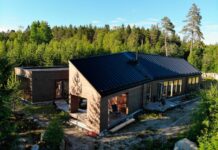
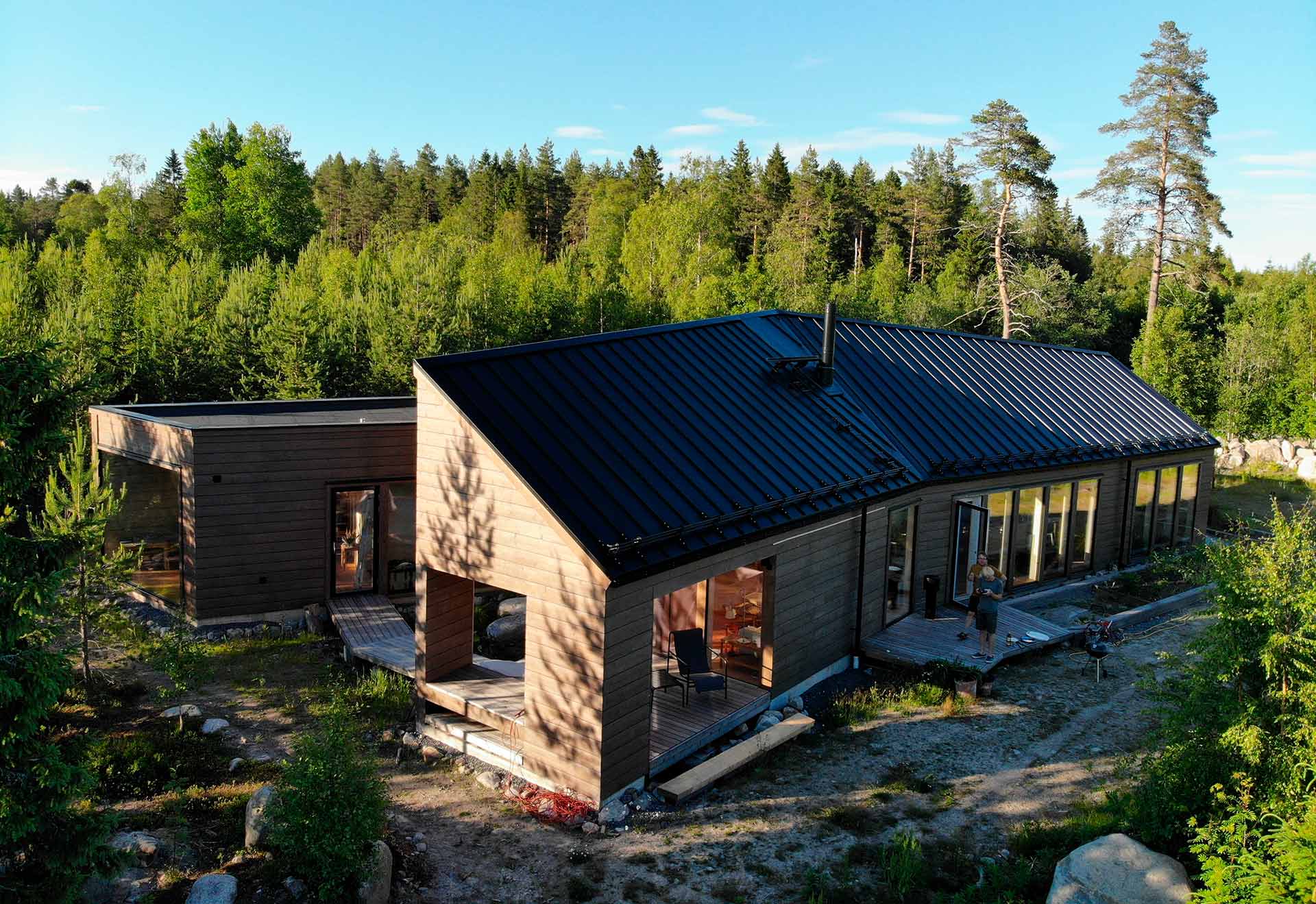
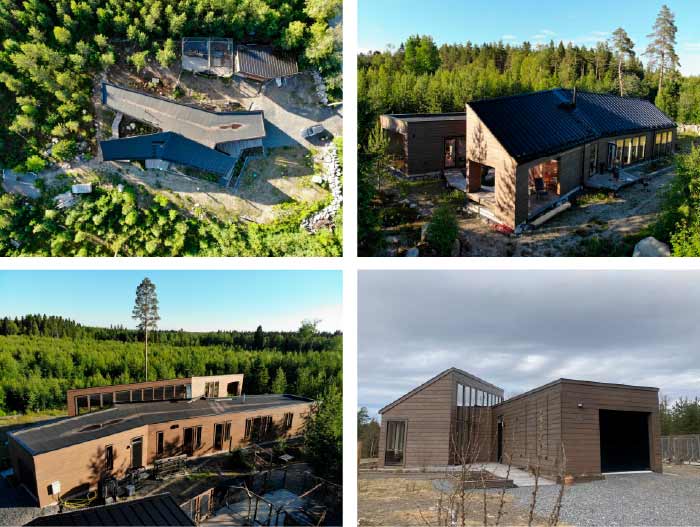
Fortunately, a Finnish family-based company ‘Polarlifehaus’ had the know-how and computer-operating CNC saws to cut timber of any angle and shape. The architects came up with three different models, and I immediately decided to go for what we coined “the chromosome”, an asymmetrical X-shaped building (Fig 2, Upper left).
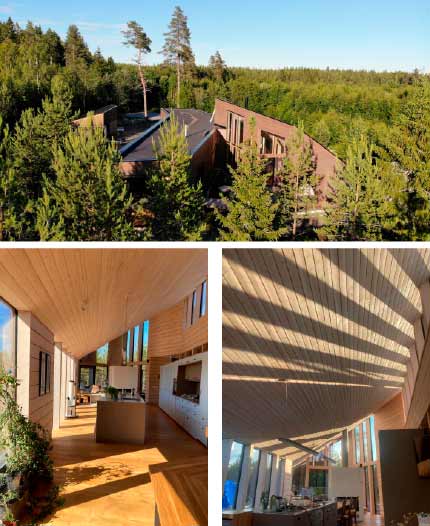
One roof slopes gently down towards the south, reducing glare completely without overhang (Fig. 2 Upper right). The south-facing roof is adapted to the Sun’s angle, so we still have floor-to-ceiling windows that are shielded from the long summer’s direct sun (Fig. 1 Lower left). The windows of the common area to the north are double tall, opening up to the sky (Fig. 1 Upper panel, Fig.2 Lower left and right). All windows are essentially frameless, so you only see the timber and the glass” (Figure1, Lower left).
The sloping roof and high windows towards the north add to the general idea, that the shadows from the beams can be reflected onto the ceiling (Fig 1, Lower right), thereby telling the passage of time, which adds to why I favour open angles. In nature, there are no right angles —they don’t exist.
In this way, the house really is a tribute to the sun’s movement, human physiology, and our relationship with nature.
A side effect of daylight planning is that the house consumes very little energy, since passive solar heat from early spring to winter (February/March) helps heat the space.
Some of my favorite buildings are The Green Solution House at Bornholm, Denmark, and the refurbished Sulston Laboratories building of the Wellcome Trust.
“The Green Solution House, designed by 3XN, is taking a holistic approach and is showcasing several cradle-to-cradle principles and green, sustainable solutions. It puts daylight into perspective and how to handle the site and the regional daylight”.
The Wellcome Genome Campus Cambridge is a research institute in Hinxton, UK. The Abell Nepp Architects designed a common spacious dining area with glare-free daylight and direct access to outdoor gardens and paths, bringing about happy scientific workers.
Instead of the usual praxis to place scientists anywhere, in any room, they set out to build specifically to highlight the importance of creativity and interaction between scientists, showing that they really appreciate their work and wellbeing.
Q: Do you think architecture should account for morning versus evening sunlight (time of day) and summer vs winter sunlight (seasonal contrasts)? How can architecture balance exposure to and protection from sunlight.
I made a precise morning and evening light plan to get the orientation right in our house. All bedrooms (also with floor-to-ceiling windows) face north and west, to block the early morning sun from the northeast, rising at 02.15 AM.
The architects designed a flat roof for the more private rooms, blocking passive solar heat during summer (Fig 2, Lower left). Hence, we do not need blinds. The flat roof’s lower height is designed so that the daylight from the north is used to illuminate the common space.
The kitchen, dining, living, and laboratory areas belong to a common space facing south (Fig 1, Lower left and right). It has a central stove and a fireplace, and it is here where we spend most of our time, receiving all the winter sun and twilight through the ceiling-to-floor windows made with special clear, high-transmittance glass.
Q: You have an impressive career within chronobiology, sleep, and circadian adaptation, with links to architecture. Your project, ‘Living by the light in a glass house,’ exemplifies this. It was first done in Bornholm in 2016/17 and is currently in Granö, a rural village in Västerbotten County. How do you see these concepts translated into design, ideas, and solutions for the built environment today and in the future? Do you see a sustainable, climate-responsive, and healthy future?
The Photon Space is a uniquely dedicated glass architecture for daylight research, designed and constructed by Cantifix, UK. It is the only experimental facility in the world that allows this research all year round due to its comfortable indoor climate.
The study volunteers have an unprecedented experience of summer twilight, winter stars, and northern lights. In our current study, they typically spend 72 hours in the Photon Space. They love it – they are no longer stressed, instead, they feel calm and relaxed. Surrounded by forest, they feel part of nature, but they are equally exposed to the view of others, and this may concern certain people.
The Photon Space is not intended as a permanent house to live in; rather, it is a test-laboratory to record measurable human responses to a seasonal climate. It is meant to sharpen the awareness of what it is like to live with natural light.
I think it is possible to scale up the ‘Photon Space’ idea in search for better, less harmful ways to live in urban areas, while maintaining fulfilling lives. Bigger-sized floor-to-ceiling windows with clear glazing are certainly a way forward at higher latitudes.
An example is the Eco-house in Tomtebo, a communal multi-story building with a winter garden atrium and direct access to 32 flats.
Q: Do you think we have forgotten something from the past when we design buildings today? If so, why would we forget or disregard such cumulative wisdom? (And what can we do about it?!)
Vernacular architecture used to be more sensitive to daylight. Daylight availability was previously a necessity for work. Designers also used spaces where they knew sunlight would be transformative for perceptual moments. Perhaps we have not forgotten, as we still treasure certain buildings, but some designers surely tend to ignore or neglect daylight’s power for human health.
Since city-dwelling people are being systematically removed from nature by urban planners, I am worried about the future of nature. Our species depend on nature, not the other way around. We need to build with daylight being considered a ‘building material’ that must touch soil’s vegetation blanket and enter our living spaces.
Similar applies to darkness at night. We need easily accessible green spaces in urban areas to have an immediate relationship with nature. I recently co-authored an article on this matter, ‘Why daylight should be a priority in urban planning’, supported by The Daylight Academy. You can read more; https://www.sciencedirect.com/science/article/pii/S2226585624000190.
Finally, how much our built infrastructure intrudes into natural habitats is now recognized as an essential sustainability issue – in particular here in the north where reindeer herding depends on land without windmills, river dams, roads, railroads, and mega-mining projects which damage land and water and ultimately contributing to changes in surface hydrology, groundwater levels, flow path and earthquakes.
Addressing new ways to restrain ourselves from the destruction of natural habitats and from uneconomically using land surfaces is increasingly relevant for architecture and design education.
As a faculty member of the interdisciplinary initiative “Moving Boundaries Collaborative,” I undertake work with students and professional architects and designers, teaching about life at different latitudes, environment-behavior relationships, and human neurodiversity, explaining our elusive sensitivity to daylight and the natural world.