Photo/image by: Nadja Baltensweiler
Personal light exposure has become a central construct in light-and-health research: many researchers now routinely use wearables and environmental sensing to capture the light people experience in daily life and connect it to health-related outcomes, such as sleep and mood. Yet despite growing data volume, the field still struggles to accumulate evidence systematically.
The reason is simple: the field lacks common ways to collect, store, describe, and analyse personal light exposure data. Due to the current heterogeneity in the research landscape, datasets across labs, devices, and countries are often incompatible, making meta-analyses challenging, and the field continually reinvents the wheel.
Our team’s current research focuses on removing that bottleneck: building open tools, shared workflows, and FAIR-aligned data practices so that personal light exposure research can scale globally and reproducibly.
Why “personal light exposure” is not one variable
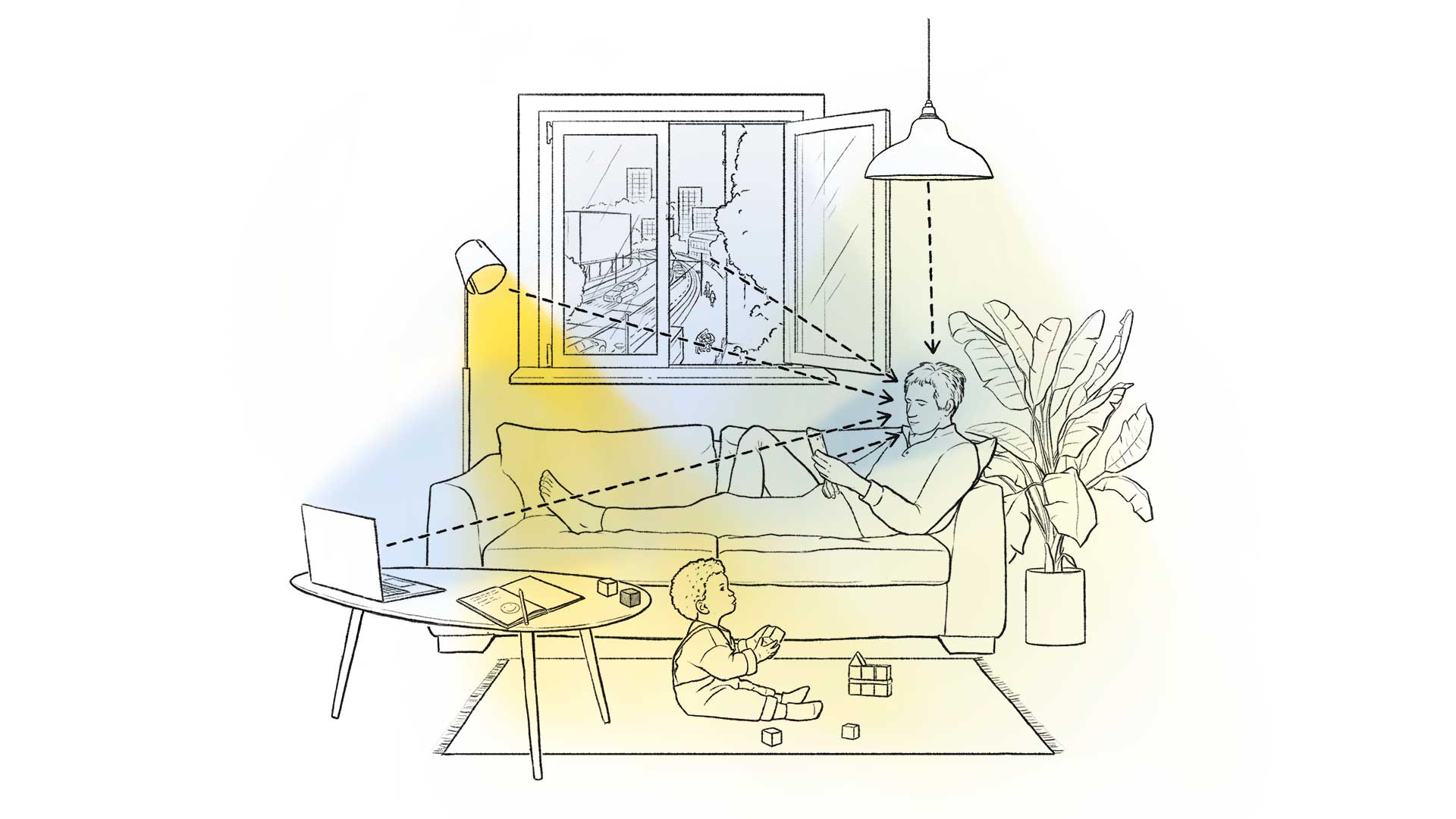
“Personal light exposure” sounds straightforward to measure, but it’s a shorthand for a moving target: our visual environment changes constantly in terms of intensity, spectrum, timing, and context.
When we attempt to relate exposure to sleep, circadian phase, mood, or vision outcomes, we quickly encounter a core problem: we lack a single model (yet) that consolidates exposure patterns across these outcomes. Instead, the field uses many metric families and dozens of specific metrics, each emphasising different aspects of exposure, including level, timing, spectral composition, history, and dynamics.
This makes the choice of metrics a substantive scientific decision, not a minor analytics step. It also makes comparability across studies fragile unless we converge on transparent, community-accepted conventions.
Real-life light data are messy
Wearable light exposure data are time series from everyday life. That means non-wear, inconsistent placement, missed logs, and – crucially – lots of zeros. Many datasets are therefore zero-inflated due to many “dark” data points (in particular at night), so modelling and visualisation need to explicitly handle darkness through appropriate error models or principled preprocessing choices.
Otherwise, two studies can report “different effects” when they used different assumptions about how to treat the same kind of data.
Devices, compliance, and context shape the signal.
Another practical reality: device selection isn’t neutral. Wearability, appeal, and usability influence compliance, and placement choices can change the recorded exposure profile.
For that reason, we’ve been emphasising the role of auxiliary data – sleep/wake, wear/non-wear, activity, light sources, environmental context, and experience sampling – to interpret the sensor output and implement meaningful quality assurance/quality control (QA/QC). Without this context, “objective” wearable data can become difficult to interpret and even more challenging to reuse.
A practical response: shared, open pipelines
Because individual labs can’t (and shouldn’t) build bespoke pipelines forever, a major part of our work is developing and supporting open, reproducible analysis workflows. A key example is LightLogR, an open-source, permissively licensed R package designed as a one-stop shop for wearable light logger and optical radiation dosimeter data: import, validation, processing, metrics, and visualisation. Future users of LightLogR can access two open-access training courses.
This work also connects to the broader metrology effort within the MeLiDos project, which aims to improve the comparability and utility of wearable light-logging and dosimetry data across devices and studies.
The goal isn’t to enforce one tool. It’s to enable shared language and shared defaults: when many studies implement transparent, versioned workflows, results become easier to compare, review, replicate, and extend.
FAIR data: making each study a reusable puzzle piece
Even the best pipeline won’t matter if datasets aren’t reusable beyond the original paper. That’s why we see the FAIR principles (Findable, Accessible, Interoperable, Reusable) as the bridge from “a study” to “infrastructure”. In practice, FAIRness for light exposure data means reporting and preserving what future users need: device descriptors, calibration transparency, protocol details, QA/QC decisions, and relevant auxiliary data.
This is also why community-aligned metadata guidance is so necessary. Every dataset can become a vital puzzle piece – but only if it is curated and shared in ways that allow integration and comparison.
The bigger picture: light in the built environment needs global evidence
Why focus so much on standards and workflows? Because the questions we ultimately want to answer – how lighting in homes, schools, workplaces, hospitals, and cities shapes health – demand evidence that is cross-cultural, cross-climate, and cross-technology. The built environment is not a single entity.
If our evidence base remains Western, urban, and device-specific, it will be hard to translate findings into robust guidance or policy. We have made inroads into this problem through a recent analysis of light exposure in Malaysia vs. Switzerland and the A Day in Daylight event, in which 50 people around the world measured light exposure from dateline to dateline.
Next step: the Global Light Commons
Shared tools and FAIR practices are necessary, but not sufficient. The next step is infrastructure that makes global synthesis routine. That is the vision behind the GLEE project and its Global Light Commons: an open, standards-based ecosystem to harmonise real-world light-exposure and optical-radiation datasets so they can be combined, compared, and stewarded over time.
The call to action is clear: if we want the field to move fast and stay rigorous, we need to combine forces – standardise workflows, share data responsibly, and build a commons rather than rebuilding pipelines in isolation.
Johannes Zauner, PhD, Salma Thalji, MSc & Manuel Spitschan, PhD
Translational Sensory & Circadian Neuroscience Unit (MPS/TUM/TUMCREATE)